Showing posts with label tea. Show all posts

Wednesday, 25 February 2015

Twinings: Lemon Zest

Not too long ago, I received a large Twining box through the post containing an assortment of different teas.
One of these, was a single teabag of a tea named 'Lemon Zest'. As a huge fan of lemon as a flavouring I was naturally eager to try this unusual sounding blend.

On my blog I haven't really explored fruit-based teas although they are one of the teas that I am most fond of. When I tried Twinings: Lemon Zest, it quickly became one of my favourites.


If you're looking for a refreshing, soothing and rejuvenating tea - this is it. As well as tasting wonderful, Twinings: Lemon Zest is truly warming and reviving. This tea reminds me of a sherbet lemon drop; both gloriously sweet and sour at the same time.
Despite there possibly being a conception that lemons are always sour and maybe a tea flavoured like them would not be very enjoyable; with this particular blend that couldn't be further from the truth. This tea has a back-note of very gentle sweetness which adds to the enchanting aroma that steams from the cup.

I cannot urge you more to give this tea a try, it will definitely surprise you; it would also be great if suffering from a sore throat, as it has a tranquil and yet pungent flavour that would revive your senses; as well as sooth them.

I brew my tea for around 5 minutes or even longer as I enjoy a much stronger flavour - if you prefer a more subtle taste then brew for around 3 minutes; and of course don't add milk.
Boxes of 20 tea bags can be bought from the Twinings website here for £1.49; they are also available at some supermarkets.

© Photography taken by and copyright to Elizabeth Mawson and 'Tea is Always a Good Idea'.

Saturday, 24 January 2015

Twinings: English Breakfast

So, after just a little over 3 months of university work and Christmas celebrations and festivities; I am finally back to my blog.

To begin the year I thought I would start with an ever popular classic. The Twinings English Breakfast tea.


This traditional blend is possibly the most popular tea of the Twining collection. It is the cup of tea you are most likely to get at a meeting or seminar; or at a cafe if you ask just for 'tea'. It is also the choice of my University who serve it throughout the day as their typical cup of tea.

This blend can be left to brew (as any black tea) to achieve a stronger flavour, but it still manages to capture a sweet and subtle flavour, which is completely unique. It is full of flavour and honestly I think would be liked by everyone.

This is part of the Twinings 'traditional' selection, which also includes my previously reviewed 'Everyday Tea', along with 'Traditional Afternoon'. So, if you're thinking of trying a new tea to accompany your breakfast over the next week - I urge you try Twinings: English Breakfast, it sure to be a great success!

I steep my tea for around a minute or slightly longer, and take it with milk and sugar.
Twinings English Breakfast tea can be bought at most supermarkets for £2.79 for 50 tea bags. Alternatively a single tea bag can be bought off the Twinings website here for £0.25.

© Photography taken by and copyright to Elizabeth Mawson and 'Tea is Always a Good Idea'. With help from Billy Warford.


Tuesday, 21 October 2014

Twinings: Darjeeling

Since having an interest in teas and different varieties, a name I have often come across is 'Darjeeling'.
This is an Indian tea from a district in West Bengal, surprisingly enough called 'Darjeeling'. Today I tried it for the first time and wasn't disappointed.


Darjeeling tea has a wonderful golden colour, it almost mirrors the sunlight from where it is made. This blend is slightly different from other Indian teas, as it is made from a small leaved Chinese plant called Cameilla Sinensis.
The most common form of Darjeeling is black tea also but it also comes in the form of Darjeeling Oolong and Darjeeling green teas.
It is said to have it's delicate and fresh taste due to the high altitude where it is grown on the foothills of the Himalayas; tea started being planted in Darjeeling in the 1840's, all due to a civil surgeon called Dr. Campbell. He was reportedly moved to Darjeeling in 1839 where he planted some apparently stolen seeds; then other people followed. Soon, the British government created more tea nurseries and by the 1850's and 60's commercial development had begun and there were at least 4 gardens belonging to the Darjeeling tea Company.

When I tried Darjeeling, what surprised me most was that it was not completely unlike everyday normal tea. But then the more I drank it the more I tasted the roots from which it is grown; I could almost taste the smells of an indian bush, the dry grass and sandy plains - which was surprisingly pleasant. The flavour could also be described as slightly metallic. However, the taste is golden and delicate leaving a strong aftertaste which could almost be floral. As all of Twinings teas, this blend is smooth and very enjoyable, the envelope also describes a short story of the journey of the Darjeeling tea leaves, which is rather adorable to read.

I was surprised how much I enjoyed this tea, it was satisfyingly aromatic and warming, and would be a perfect way to end an evening meal if you want to avoid have a large amount of caffeine before bed.
Personally I would recommend it to anyone to try, as it isn't that far away from the traditional tea we are all used to.
I steeped my tea for 4 minutes and added a small splash of milk. The taste can be pungent so if you prefer weaker tasting teas I would recommend steeping for 3 minutes or less.

© Photography taken by and copyright to Elizabeth Mawson and 'Tea is Always a Good Idea'.

Monday, 20 October 2014

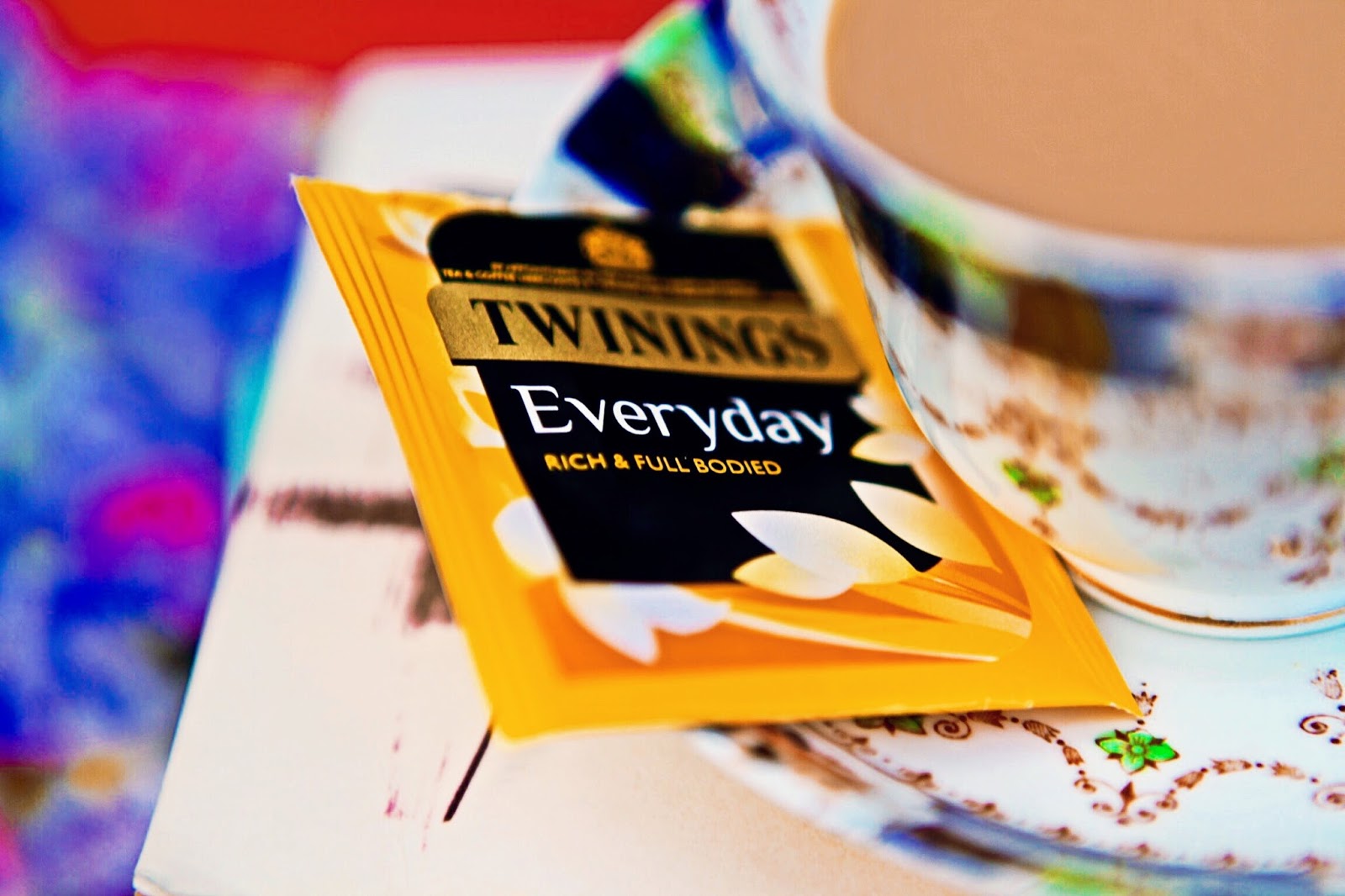
Twinings: Everyday

Despite being a lover of many fruit and herbal infusions and assorted black and green teas I always seem to return to the traditional blend of 'Everyday Tea'. If I'm unsure how I'm feeling, or if I feel a little low, I don't tend to to turn to a fruit burst infusion tea; but the completely normal blend of black tea. The type that if you went into a tea shop and asked for a 'pot' this is what you would get.

Today I decided to try 'Twinings Everyday tea', it was a cool autumnal afternoon, and this was a perfect and relaxing accompaniment to a lazy day.


Twinings do a range of 'traditional' teas, including 'Everyday Tea', 'English Breakfast' and 'Traditional Afternoon'.
This particular blend is of course completely unique to 'Twinings'. It is a mixture of tea leaves from Yunnan in China, which where tea originated from some 2000 years ago,  along with Assam which is an African and Indonesian based tea.

This tea is branded 'rich and full bodied' - and it certainly is that; but somehow remarkably smooth.
There are very indulgent and rich traditional tea flavours, which are incredibly calming and relaxing. I don't think it would be possible not to enjoy this tea, it is beautifully natural, soothing and satisfying. Any tea lover would adore this blend and I would recommend it to anybody, if you like your tea strong the flavours are there and not compromised by the smooth and delicate finish. However, if you like your tea light and milky then this could easily be achieved by a short steep much like any other traditional black tea.

I like my everyday tea with plenty of flavour, so I steeped mine for around 5 minutes, I also added a splash of milk although that is completely up to you.

Twinings Everyday Tea can be bought in single packets from their website here for £0.25. Or packs of 40 can be bought for £1.50-£1.99 at most supermarkets - there are even packs of 240 available!

© Photography taken by and copyright to Elizabeth Mawson and 'Tea is Always a Good Idea'.

Saturday, 18 October 2014

Twinings: The Earl Grey

To begin my tea tasting and reviewing I'm starting with one of my absolute favourite teas, the quintessentially British Earl Grey.


Twinings, have a very special and individual blend of Earl Grey, a black tea containing Bergamot & Lemon. All of Twinings blends are unique, but this particular one is one of their most popular. I can completely see why.

History

Earl Grey tea is named after Prime Minister Charles Grey; but no one is really sure where Earl Grey tea really came from.
One theory is that after visiting China, Lord Grey was given a blend of tea with bergamot oil. Bergamot orange is a fruit from a citrus tree which is mainly grown in Italy and flowers in the winter.
Legend says, that one of Lord Grey's men saved a Chinese mandarin's son from drowning; this mandarin later gave Lord Grey the gift of bergamot scented tea. Although, no one is sure how true this is, as apparently Lord Grey never actually visited China.

To quote the Twinings website:
"It all started with Richard Twining in 1831 when Prime Minister Charles Grey asked him to replicate a tea he'd been given. With one sip he loved it so much he put his name on it!! We love this story so much and are so proud of our ever growing range of Earl Grey."

However, Jackson's of Piccadilly claim that the recipe has never left their hands as Lord Grey gave the recipe to George Charlton, a partner at Robert Jackson & Co, and has been in production in China ever since.

Once I watched a documentary which contained an interview with the Grey family. They claim that the blend was developed by a Chinese mandarin specifically for Lord Grey, and made to suit the water at Howick Hall where he lived in Northumberland where there was a lot of lime in the water; and that's why bergamot was used - to try and counteract the taste. Then, Lady Grey had the tea served when she entertained in London, the tea was very popular and many people wanted to buy it from the Grey family for their own use, which is when Twinings began to market the tea.

So who knows which story is true, but personally I think that since Earl Charles Grey's signature is printed on every packet and box of Twinings Earl Grey tea, and this was said to be his favourite blend - I may be inclined to believe the Grey family's story.

Having tried other brands of Earl Grey, this has always been my favourite. Personally I like my teas with real flavour, so stronger than some people. Earl Grey can be a very subtle and weak tasting; however with this particular blend I tend to leave the teabag in the water for 4 minutes. This really lets out the flavour and you get a wonderful flowery and delicate taste and scent.
This tea isn't weak or watery at all, and I really enjoy it. Although there is a very floral backdrop to it, there is the traditional tea flavour that I'm used to. I like it both with or without milk - although most people's preference is with milk.

If you dislike floral tastes and blends in your tea I wouldn't recommend this, as that it's main flavour. But if you don't know, or are trying to branch out into a different type of tea then this would be a great place to start.

You can buy a single teabag sachet off the Twinings website here for £0.25.
Alternatively you can buy a box of 20 for £1.49 in most supermarkets.

© Photography taken by and copyright to Elizabeth Mawson and 'Tea is Always a Good Idea'.